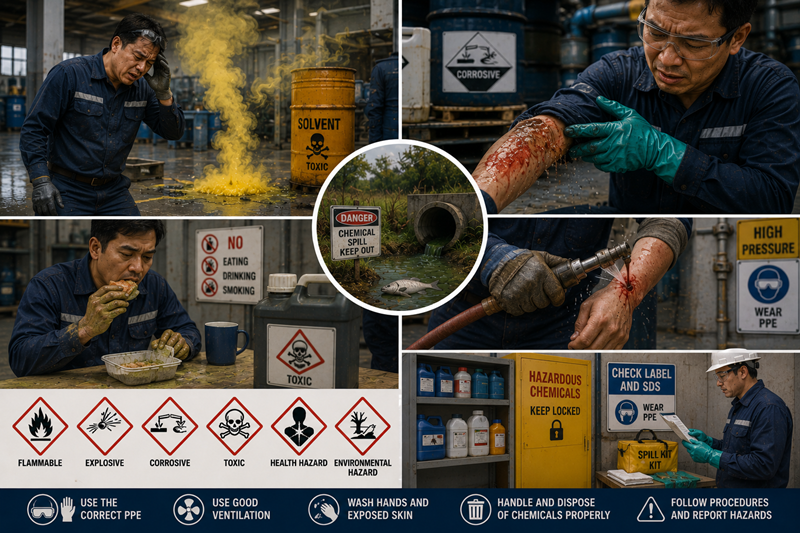

Why are Chemicals Dangerous?
Many chemicals used in the workplace can harm people, damage property, or pollute the environment if they are not handled, stored, or controlled properly.
Chemical effects may happen immediately, which is called an acute effect, or they may develop slowly over time, which is called a chronic effect. HSE gives examples such as immediate effects like dizziness or stinging eyes, and long-term effects such as lung disease, which may take years to develop.
Chemicals can be dangerous because they may be:
- Flammable – they can catch fire when exposed to heat, sparks, flames, or other ignition sources.
- Explosive or reactive – some chemicals can create fire, explosion, pressure, or heat if mixed incorrectly or exposed to unsafe conditions.
- Corrosive – they can damage skin, eyes, metal, containers, or equipment.
- Toxic or harmful – they can affect health if inhaled, swallowed, injected, or absorbed through the skin.
- Environmentally hazardous – they can harm soil, drains, waterways, animals, plants, or marine life if released.
Chemicals can affect human health by causing:
- skin irritation, dermatitis, or chemical burns
- eye irritation or serious eye damage
- breathing problems or respiratory disease
- headaches, dizziness, nausea, or poisoning
- sensitisation, where the body becomes more reactive after repeated exposure
- long-term illness after repeated or uncontrolled exposure
- serious injury or death in severe cases
Chemical hazards must never be underestimated. Before using or responding to a chemical spill, workers should check the label, read the Safety Data Sheet, understand the hazards, use the correct PPE, follow the procedure, and report unsafe conditions.
Chemicals are not only dangerous when a large spill happens. Even small amounts can be harmful if the chemical is highly hazardous, the exposure route is uncontrolled, or workers do not use the correct protection.